
Sheikh Zayed Mosque
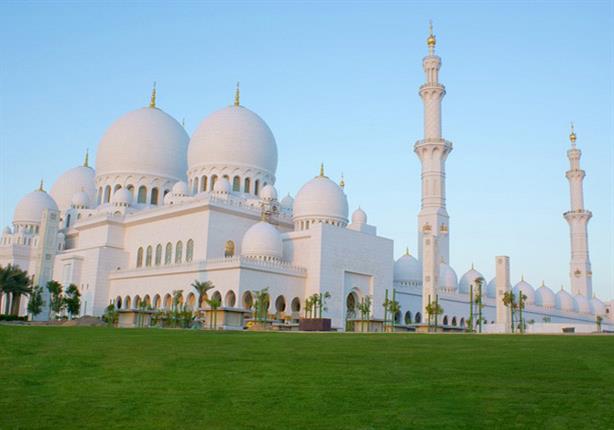
The Sheikh Zayed bin Sultan Al Nahyan Mosque is a prominent Islamic edifice in the UAE. The mosque is located in the city of Abu Dhabi and is known locally as the Sheikh Zayed Mosque or the Grand Mosque or also the Sheikh Zayed Grand Mosque. It is the fifth largest mosque in the world in terms of total area after the Grand Mosque, the Prophet’s Mosque, the Umayyad Mosque in Damascus and the Hassan II Mosque in Casablanca with an area of 412.22 square meters without the reflective lakes around it, and one of the ten largest mosques in the world in terms of the size of the mosque. The mosque can accommodate more than 7,000 worshipers inside, but it is possible, with the use of external spaces, to accommodate about 40,000 worshipers for all sections of the mosque building, and its distinctive features are the presence of four minarets in the corners of the outer courtyard, 107 meters high for the minaret completely clad in white marble.
The late Emirati president, Sheikh Zayed bin Sultan Al Nahyan, had directed the construction of this mosque in 1986 through the Department of Public Works in Abu Dhabi, seeking to make this mosque an Islamic edifice that consolidates and deepens Islamic culture, its concepts and religious values, and a center for Islamic sciences. Where he announced the start of designing the mosque in the form of an international competition, and the first prize was won by the Consulting Office of Concert in Abu Dhabi, then the competition was repeated in 1987, and the Arab Belgian Office Company (Tractebel Gulf currently) won the competition over 35 countries participating in the competition. The mosque was under the management of Eng. Youssef Abdalke, and there were major architects who completed and developed the design, namely: Engineer Bassem Barghouti, Engineer Moataz Al-Halabi, and Engineer Imad Malas. And after hundreds of engineers worked on its development and under the supervision of the Department of Public Works in Abu Dhabi. The first prayer that was performed in the mosque was the Eid al-Adha prayer in the year 1428 AH (December 19, 2007), but at that time the construction work in the mosque was not completely finished. The construction work was completed in March 2008. The total cost of the project amounted to two billion and 167 million dirhams.
Construction work: The construction work started in 1998 under the supervision of the Department of Municipal Affairs. The project was implemented in two phases. The first included building the foundations and the concrete structure, and its cost amounted to 750 million dirhams. As for the second phase, it included the interior and exterior finishing and decoration works, and it cost one billion and 267 dirhams. An amount of 150 million dirhams was also spent on external works. The mosque was built at a height of 9 meters above street level on the orders of Sheikh Zayed personally, so that the mosque can be seen from different angles and from a distance. Several companies worked on the project, as a number of companies stopped at different times for several reasons. The English company Halcrow began its work as a consultant on the project in 2001, and worked with the Italian contracting company Impreglo to finish the project.
The mosque from the inside: The number of columns inside the main prayer hall is 24 columns bearing huge ceilings and domes, and designed so that one column is divided into four pillars, carrying the arches carrying the domes. These columns are covered with white marble inlaid with mother-of-pearl in pink and vegetal motifs, which add beauty and elegance to the hall. The internal dimensions of the mosque are 50 meters by 55 meters, and the ceiling height is 33 meters from the ground to the main dome, with a height of 45 meters.
Mosque carpet: The mosque’s floor covers the largest carpet in the world, with an area of 5,627 square meters and designed with fine and beautiful arts that give the mosque the uniqueness. The rug is hand-made and woven in Iran by the Iran Carpet Company, with 1200 weavers, 20 technicians and 30 workers. It has 2,268 million knots, and the rug weighs 47 tons, 35 tons of which are wool and 12 tons of cotton. Cost the carpet about 30 million dirhams.
Mosque domes: The main dome of the mosque is the largest in the world, with a height of 83 meters and an internal diameter of 32.8. The dome weighs a thousand tons, and the interior is decorated with fiber-reinforced plaster, designed by Arab artists with unique floral motifs, designed specifically for the mosque, in addition to writing Quranic verses. The number of domes in this mosque is 82 domes of different sizes, covering the external corridors and the main and side entrances.
The courtyard and the surroundings: the outer courtyard of the mosque: The floor of the outer courtyard of the mosque was designed to be a system of huge concrete slabs mounted on concrete pillars, and covered with the finest types of marble decorated with colorful vegetal designs and using mosaics to cover the entire courtyard area of 17,000 square meters, among the largest existing open spaces In mosques in the Islamic world. The number of columns in the outer courtyard in the corridors surrounding the courtyard is 1,448, covered with marble inlaid with semi-precious stones, and with floral designs and colorful flowers, with gold-plated metal crowns. The outer corridors of the mosque were surrounded by water lakes that reflect the facades of the mosque, which adds to the design distinction, and its floors are covered with white marble with the use of green marble in the corridors that lead to the courtyard. Skilled workers specially brought from India, in addition to the crown of the columns, which is designed in the form of a palm-shaped aluminum gilt. In addition, in both the north-east corner and the south-east are places of ablution, consisting of 80 toilets and 100 ablution points.
The preacher and the imam: The preacher: His Eminence Sheikh Waseem Youssef. . . Imam: Reciter Idris Abkar.- Reciter Yahya Aishan.
Al-Jami Library: It contains three thousand titles, distributed in various scientific and cultural fields, in more than a dozen living languages, including collections of valuables.